Saturday, October 13, 2012


I had two rather odd dreams the other night, and I invite anyone to give me an interpretation.  They both deal with death, though no one in my immediate circle is contemplating it.


In the first dream, I was being executed for murder.  This was odd since I am not the type.  It was, of course, a murder that I hadn’t committed, but I had been duly tried and sentenced, and there I was strapped to a table while the authorities were shooting voltage through me.  The problem was that I didn’t die, and they kept on trying, and I kept asking if there wasn’t a point at which they accepted that I wasn’t meant to die and let me go.


Then I woke up and didn’t dare go back to sleep.  But I did anyway and dreamt that I was now in business school.  This was as unlikely a venue for me as the execution chamber, but there I was, and my assignment was to write a letter to a customer.  The letter I wrote was as follows:


Dear Mr. Twitchell.  Thank you for your continuing loyalty to Deep Water Cruise Lines.  Let me assure you that repairs to the railing have been made, and accidents like the unfortunate loss of Mrs. Twitchell off Key West are not likely to reoccur.  Best wishes to you and the new Mrs. Twitchell, and we look forward to hosting you again in February.


As I said, I welcome any and all interpretations.


Monday, September 24, 2012


Well, it seems I was wrong about Queen Elizabeth.  I did receive a reply in the form of a letter from a lady-in-waiting at Balmoral Castle thanking me for my letter.  Apparently, Her Majesty was amused.


In addition to corresponding with queens and ladies-in-waiting, I have jumped into the audio book market by releasing a novella that I wrote a few years ago as a two-hour CD.  It’s entitled “Gordon,” and it’s a fable for adults, “Wickedly Funny.”  Following is the promotional copy from the back of the album, and it may interest you:


 Gordon Herzog’s wife is divorcing him, his girlfriend is callous to his emotional needs, his secretary is disrespectful, and his boss is sleazy.  Gordon despises his own career, drinks too much, is going to pot physically…..and then something bad happens.

GORDON is a fable about a man in mid life with one leg on Madison Avenue, the other in trendy, creative Westport, Conn., and both knee-deep in trouble.  But there is nothing unique about his situation…so why does what happens next happen?  But, undeniably, it does.

You will scorn and despise, pity and even love Gordon as you share his frustration and pain, if not necessarily his approach to solving his very unusual problem.  And you will laugh.

GORDON is a mystery (watch out for the heavy language) a satire, and a fast-paced adventure of a man battling against…well, you’ll have to decide for yourself.


At this point, the only source for “Gordon” is me.  Soon I hope to have it on Amazon and Barnes & Noble, but that will take some time.  You can obtain a copy by sending your name and address along with a check for $16 to:

Julian Padowicz, 1397 Hope Street, Stamford, CT 06907.


Wednesday, August 8, 2012

Those of you who read a recent posting of mine regarding a letter to Queen Elizabeth will
understand the eagerness with which I watched her face during the playing of
“God Save the Queen” at the recent opening ceremonies for the Olympics. Perhaps, like me, you were also watching for any slight sign of amusement.
I saw none. Like her oft quoted great grandmother, Elizabeth was not amused. From this I
conclude that either the queen or her secretaries do not have a sense of humor.

Thursday, July 19, 2012

Last Sunday, my wife and I had the long anticipated pleasure of a visit from some relatives
of mine, whom I had never met, from Israel. Nechama Padovitz is the widow of Marek, who was the son of my father’s brother. Since my father died when I was a year old, I’ve never known anyone from that side of my family, hence the anticipation. Accompanying Nechama to Stamford were her son, Amiri, his wife, and their two children.

They are all lovely people and their short visit was lovely as well, despite th deluge of rain and the crahing thunder outside. But what was most interesting was the story they brought us:

You see, I’ve always been curious as to why my Jewish heritage should have as Polish a name
as Padowicz. In Polish the name implies someone who comes from Padua, Italy, the way the name Londoner implies origins in London. Well, according to Cousin Amiri, one of our ancestors was a physician named Ezra who was indeed living in Padua. And one day Dr. Ezra was called to attend a patient named Napoleon Bonaparte.

What Napoleon’s complaint was is lost to posterity, but it seems that Ancestor Ezra did such a great job dealing with it that the emperor made him his personal physician and invited him along on his visit to Moscow.

As we all know, Napoleon had not been invited to Moscow, and he did not find himself particularly welcome there so he soon embarked on a trip home. And Grandpap Ezra, who must have known something about Russian winters that Napoleon didn’t, opted out of the trip back and stayed behind somewhere in Russia.

There he begat more Ezras until the Tzar passed an edict that all Jewish boys, except the eldest in any family, had to serve in the Tzar’s army. Life in the Tzar’s army was no bed of roses for Jewish boys since they were sent into battle ahead of their brothers-in-arms so that the enemy’s cannon would shoot their wad against them, giving those brohers-in-arms a chance to advance while the cannon were being re-loaded. This is known as “cannon fodder.”

And, as it happened, one of Dr. Ezra’s descendent's wife gave birth to two sons. So in order to protect the second one, the father registered him not as an Ezra, but under a name he made up, the totally Slavic, Padowicz. And so it turns out that I and my children are descended from Napoleon’s personal physician, a man smart enough to let Napoleon start home from Moscow without him.....unless, of course Mrs. Dr. Ezra had a secret affair with her husband's illustrious patient.

Thursday, June 21, 2012

A couple of weeks ago I sent the
following letter to Queen Elizabeth:

Madam,
Following is a story your Majesty may find amusing, particularly as it
involves her late father.
In the summer of 1941 I was a nine-year-old Jewish escapee from the
Holocaust. The year before, my mother
and I had escaped from occupied Poland in rather dramatic fashion, the event
subsequently recounted in a number of books, and were living in New York with
my uncle, the artist Arthur Szyk, known to your Majesty’s parents.
Sent to summer camp in Massachusetts to learn the language and become
Americanized, I learned to sing the British national anthem which we did in
support of the struggle your country was waging at the time. And, much to my satisfaction, I found that I
understood almost all the words. I even
realized that “reign” couldn’t possibly mean “rain.”
Where I did have to do some speculation, however, was in the line, “Send
him victorious, happy, and glorious.”
Neither “victorious” nor “glorious” were words I had yet
encountered. But I knew about Queen Victoria, and it did not take a genius
to realize that “Victorious” must be the masculine form of the same given name.
Further reasoning led to the conclusion that this Victorious must be a historical figure, some Lancelot who had, most
likely, saved Britain once and was being called on to come to the aid of the
beleaguered king. The same went for Glorious, and, to this day, I visualize
King George on his throne, flanked by the heroic Victorious and Glorious
resplendent in their armor.
And as for Happy, well every
nine-year-old knew him to be one of the Seven Dwarfs, and any nation that drew
its inspiration from Disney as well as history could not be conquered by the
likes of Hitler.
Most sincerely,
Julian Padowicz

I have no idea whether the queen has seen or ever will see my letter. But I will watch closely any future television of her majesty attending to the playing of “God Save the Queen” for
any signs of her experiencing difficulty maintaining her composure.

Friday, June 1, 2012

Last week my
wife, Donna, and I flew to California to help our youngest grandchild, Nash,
turn two. On the airplane and in the
terminals, as I have for the past six years, I paid close attention to what the
other passengers were reading in the hope that one of them would be reading one
of my books.
In my mind I
carry a scenario in which I ask the person how they enjoyed the book and then
reveal that I am its author. They are impressed,
I sign their book, and we carry on a conversation until the flight attendant
tells me to get back in my seat and buckle up.
Of course it
hasn’t happened yet, outside my own mind.
But last Friday morning, as I was on the homeward leg of my Hope Street
run, a car came to a stop beside me and the window opened. I expected to be asked directions to the
Merritt Parkway.
“I’m so glad
I finally ran into you,” said the attractive woman at the wheel. “I’ve been carrying your books around in the
car for weeks, hoping to run into you, so you could sign them.” It appears that I had accosted her some time
earlier, as she minded her own business at a stop sign, and forced my flier on
her. She had gone ahead and ordered two
books from Amazon and had been hoping to run into me ever since.
As she dug
for the books in the back seat, I was sure they would be “Mother and Me” and “A
Ship in the Harbor,” the first two of my three Holocaust memoirs. I was wrong.
The top book of the two she hauled out was the novel, “Writer’s
Block.”
I signed it
but, as I prepared to sign what I assumed to be the sequel, “The Best Sunset in
Venice,” I discovered it to be a second copy of “Writer’s Block.” I asked why she had two copies, and she said
she had loved the book so much that she had ordered a second copy for a
friend. As I wrote something in the
books, I mentioned that there was a sequel entitled “The Best Sunset in
Venice.” She said she would order a copy
right away.
I told her
that, if she gave me a ride to my house, only a couple hundred yards away, I
could sell her a copy and even offer her a cup of instant coffee. She agreed, and we spent the next hour
chatting about the characters in the book and the characters in our lives. It was really a very special experience and
one of the very special benefits of being an author.

Monday, April 23, 2012

I have some friends to keep
me company on my runs now. You probably won’t
see them if you drive by, though some have.
There is Kip, a retired English professor turned author (No, he isn’t
me) whose bread always manages to land with the jam side down against the
floor. He’s the poster boy for bad
karma, some of it self inflicted, some his parents’ doing. His hero-worshiping father named him Adolf or
his non-nurturing mother sent him to boarding school at the age of seven.

There’s Kip’s wife, the
delectable sculptress Amanda who is creative and creatively accident
prone. In Barcelona
she had an allergic reaction to something that swelled her face to the point
that she didn’t resemble her passport photo and they couldn’t leave Spain. Or, when they got back to Venice, Massachusetts,
her late, abusive husband, Scott turned out to not be as “late” as she had
claimed, sending Kip looking for a gun and making her a bigamist. Then there’s the urbane Lill, recognized as
the finest cook and most gracious hostess in all of Venice, whom Kip almost
married and whom he sometimes wonders if he shouldn’t have.

And you probably won’t find Venice, Massachusetts
on your AAA road atlas either, though some have. It’s on the coast and, his first summer there,
Kip was invited to sail down to Florida
in November weather on a sailboat of dubious seaworthiness with a captain no
one else would sail with. Because of the
evening he had spent with the man’s wife in a hot tub and the things she had
told and shown him, he felt obliged to go.
That really came about as a result of the murder he had wandered into a
few nights earlier. He had really come
to Venice to write The Great American Novel.

Then there’s Kip’s boarding
school roommate, Alex, who shows up on their doorstep and reminds him of things
better left forgotten. But that doesn’t
happen till book four.

Book one is Writer’s Block in which Kip meets
Amanda, is smitten, and decides to quit his teaching job, burn his rickety
bridges, settle in Venice, and turn his lemon of a life into the Great American
Novel. Only, as I said, Kip’s bread
tends to land jam side down and the new writer and the old writing teacher
inside him aren’t on the same page. The
Great American Novel collapses of its own ponderous weight. It’s while he drifts rudderless in this new
community that he wanders into a murder, the lady’s hot tub, and the boat ride
invitation. Critics have called Writer’s Block “hilarious”, “memorable”,
“richly layered”, and “great reading.” (See Amazon.com for more reviews.)

The Best Sunset in Venice is where the “deceased” Scott shows up, where a
former Green Beret befriends Kip, where a woman colonel in the Israeli army
gives him a therapeutic massage, and where Amanda lets her hair down after too
much Lagavulin Scotch.

In A Scandal in Venice Kip is asked to provide a father figure to an
unfortunate teenager and finds that even the best laid plans…… Amanda, meanwhile, decides to reconcile Kip
with his memory of his departed, non-nurturing mother, and finds Anna a formidable
in-law even in death. Alexander’s Part-time Band, still in my
computer, is where Kip’s boarding school roommate shows up, while Amanda joins
a liberal church and Kip is made to doubt his writing ability.

Actually, I’ve been told
that, if you’ve read at least one of the books, then you will see my friends if you pass us on Hope Street or Ponus Ridge. Kip is the one with the Vandyke, which he
insists is not a goatee, since a goatee comes with a mustache. The willowy Amanda wears her brown hair in
braids tied off with one brown ribbon and one green one to match her one brown
eye and one green one. Silver-haired Lill,
with her classy bearing and impeccable grooming you can’t mistake for anyone
else. Alex is very large. There is also Doris, the librarian without a
neck, who claims she has a black belt in the Kama Sutra, Frank, the boat
builder, Lorna Bliss, president of Amanda’s church, and Kip’s old friend Vera. I’m the one with the baseball cap and the
droopy mustache.

Sunday, April 8, 2012

Some twenty
years ago I was invited to play in a mixed doubles tennis tournament at a
friend’s club. My partner was a lady
named Mimi, and Mimi turned out to be
a sex therapist.
Chatting
between matches, Mimi and I discussed, among other things, the sexual mores of
the younger generation. I told her what
I had observed on the campus of my daughter’s college, and Mimi told me about a
niece’s wedding that she had recently attended.
It seemed
that a few minutes before the ceremony began, Mimi was alone with her niece
doing the things that aunties do with needle and thread and safety pins at a
time like this when her niece said, “Auntie Mimi, I am so lucky to have an aunt
who is a sex therapist. Please tell me
what I need to know.”
For a few
seconds my friend pondered what she might say to her niece on the subject of
sex, three minutes before she was to walk down the aisle. Finally she came up with, “Maintain a sense
of humor at all times.”
The moment I
heard this, I realized that it was a great philosophy not only for the perils
of sex, but for the minefield that is marriage in general. It was too late to apply this newfound wisdom
to my first and second marriages, but it’s done wonders for the current one.

Friday, March 23, 2012

Last night
we had our first out-doors-grilled hamburgers of the season. Some years ago Donna bought an electric meat
grinder and now grinds her own hamburger.
That way we can be reasonably sure that it contains none of the
contaminants that make eating rare hamburger hazardous. And I like my hamburger rare.
I do make a
mean hamburger, but nothing like the ones I used to eat at a place called “Primeburger”
on New York’s Madison Avenue. I don’t
know what cut of meat they used or what they did to it, but it was wonderful
and, back in the 1960’s when I was in my 30’s and working in New York, I would
frequently have my lunch there.
There were
seats at the counter, and I can’t remember whether there were tables in back or
not, but at the front there were maybe twenty chairs set against the wall with
little attached trays like the ones they have on a high chairs. The tray would swing out for you to sit down,
then you could pull it closed and create a nice eating surface for yourself. And this was where I preferred to sit. Sometimes I’d have to wait for an empty
chair, but the wait was not long and well worth it.
One day,
when I came in, there was an empty chair beside two older ladies, one of whom was
very attractive and looked extremely familiar.
Immediately, sirens went off inside my head. Not recognizing people I should recognize and
being chided for it has been a life-long affliction of mine. Aunts and cousins have had a field day
embarrassing me publicly for this failing.
And this attractive, well dressed lady, I decided, must be one of my
mother’s New York friends. I commuted
from Connecticut, but my widowed mother had moved from Philadelphia to New York
a few years earlier and often held parties to which my then wife and I were
sometimes invited.
This woman,
however, was more familiar than just someone I was introduced to at a party. She was someone I saw repeatedly and, clearly,
I should know her and acknowledge her with
a hearty greeting and an embrace. If I
ignored her, she would certainly recognize me, have her feelings hurt, and I
would not hear the end of my social faux pas. I approached cautiously, thumbing through my
mental Rolodex of Mother’s acquaintances.
Were we on a first name basis? Should
I ask about her husband or would that get me into further complications?
The woman looked
up at me, recognition in her eyes, and I knew that I was, again, in trouble. Then, in a baritone voice that was surprising
but not unfamiliar she said, “Hello.”
I immediately
made the connection. She was the actress
Lauren Becall. I had met many
celebrities in Mother’s salon, but Ms. Becall hadn’t been one of them.
“Hello,” I
responded. “Wonderful burgers, aren’t
they?”
Ms. Becall
agreed that they were and turned back to her interrupted conversation with her
companion. I caught her saying, “So then
Bogey looks at me and….” before she lowered her voice out of my auditory range.

Friday, March 16, 2012

Last summer my behind went into spasm. I was bending over a paper trimmer on a
counter in my basement and suddenly my right butt muscle began to hurt like
crazy as it went into spasm.
I have a
thigh muscle in my right leg that cramps in the middle of the night, every once
in a while when I’ve brought my knee up to my chest in my sleep, and I know
that if I stretch it, which is exactly opposite to what it wants to do and a
very painful maneuver, the cramp will soon subside. Then I’ll just be left with a very sore thigh
muscle. But here I was standing in the
basement, which is none too clean, in my good pants, because I was on my way to
a ceremony marking the start of hybrid bus service at a transit agency that Donna,
my wife runs, and any muscle stretching that I could do at the moment was very
limited. Suffice it to say that when the
spasms were over, several long minutes later, my entire right leg was numb, my
behind was in pain, and I could barely make it up the basement stairs.
Driving an
hour to the ceremony, where Donna was already getting ready to greet the
governor and the media, was no easy task.
But at least I had a good conversation starter for the reception
afterwards.
The
following day, I betook myself to my chiropractor, a man with magic fingers
and, possibly, in league with the devil, who made most of the pain go
away. But he did forbid me to do any
running until further notice.
Further
notice did not come until some six weeks later, and I knew from long experience
that my first run would have to be a very gentle jog of no more than a
mile. Running every other day, I could
increase my distance by a few hundred yards each time until I reached my
customary five miles, two and a half out and two and a half back. I could have done more than five miles, and on
occasion I had, but I didn’t have the time.
That first
day I ran actually a little less than a mile and found myself quite tired that
afternoon. Two days later I did extend
my run to that full mile, then slept away a good deal of the afternoon. But two days after that I was still able to
do no more than that one mile. That was
five months ago. Now, after training
faithfully, I can only do a little more than two miles. And getting around is an effort the rest of
the day. Then, if rain forces me to skip
a day or even two days, I find myself back to that first mile again.
What have I
learned? I have learned that eighty,
which is the age I reached in January, is elderly. If I skimp on my running, for whatever
reason, I get out of shape real quick. And
getting back into shape takes much, much longer than it used to.
Now, I’m a
Capricorn and a classic late bloomer.
I’m doing things now that I could only dream of doing twenty years
ago. In addition, I get senior discounts
in theaters, on trains, and even at our hardware store. When people see me coming, with my white hair
and mustache, they hold doors open for me, a lovely experience after a lifetime
of holding doors open for everyone else.
But I don’t know if I’ll ever reach that two-and-a-half-miles marker
again.

Wednesday, February 8, 2012

Yes, I’m resuming this blog after a very long absence.

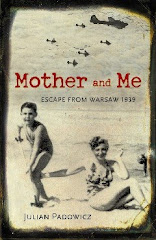
These have been two very exciting years. In 2010 my first published novel, “Writer’s Block” came out. What makes it even more exciting than my first memoir, “Mother and Me: Escape from Warsaw 1939,” which came out in 2006 is that being a full time writer of fiction has been my dream since the age of 12 or so.

Those of you who have read one or more of my memoirs will know that I was living in Poland and Jewish at the start of the war, that I had a beautiful and courageous mother who, unfortunately, missed out on the “nurturing” gene. She brought me out of Hitler’s clutches in heroic fashion, then plopped me into boarding school in America, something I was emotionally not ready for, because she had a life to make for herself in this country and didn’t really have room in it for me.

Well, “Writer’s Block” is a humorous and fictitious account of what might have become of me had I zigged instead of zagging in a number of places. My hero, Kip, was born in Germany and Jewish and brought to America and deposited in boarding school much as I was. But, while my mother soon married then proceeded to push her husband to advancement he wasn’t ready for in the diplomatic service, Kip’s mother, Anna, is a business woman who, with help from rich admirers, develops a modest chain of dress boutiques.

When Kip graduates from college, Anna wants him to come and manage one of her dress shops, and Kip runs as fast as he can to a small college in the Midwest and gets a teaching job in the English department. There he gets seduced by an attractive unwed mother whom he marries and who gives him three years of misery before running off with the assistant football coach.

Brought up in boarding school and with no experience in family life, Kip doesn’t know how to cope with all of this. His colleagues on the faculty shun him like a leper, he is incapable of engaging in a proper romantic relationship, and a new college president begins to turn the cozy little college into an impersonal university. Kip spends some thirty years doing the only thing he knows how, enduring.

Then, and this is where the story really begins, a colleague, a teacher who spent his summers in the little village of Venice on the Massachusetts coast writing successful Gothic romances, and thus enjoying a more prosperous life than the average teacher, crashes his private airplane and leaves Kip his Venice house. Kip, of course, is sure some lawyer made a mistake because things like this don’t happen to him, but he is finally convinced to drive to Massachusetts and look over his new house before he puts it on the market.

The keys to his new house, he is told, should be picked up from the village postmistress, a widow named Amanda Lazaro. Kip takes one look at Amanda Lazaro and falls in love. The fact that the fifty-something postmistress is very attractive is aided by Kip’s romantic mind finding a reason why she should have his bachelor friend’s house keys in her possession. Kip decides that he will quit his job, settle in Venice, and turn his lemon of a life into the Great American Novel…. while courting the delectable Widow Lazaro.

But Kip is the poster boy for disaster, and …… well, I don’t want to give the story away. At any rate, let me say that “Writer’s Block” is the start of a series of adventures featuring Kip and Amanda, and you’ll do well to give them a try.

Monday, May 31, 2010

So now I have my new hearing aids. They’re free from the V.A., as compared to my old ones that cost nearly $3,000 commercially. And they don’t plug up my ears, the way the old ones did. As the audiologist explained it, these units will just boost the higher frequencies, which I have trouble with, and leave me to hear the lower ones on my own. With the old ones, I could hear nothing except what the contraptions fed me. For all I know, there could have been little, tiny radio receivers inside and someone was telling me, subliminally, what products to buy and whom to vote for.
Also, these don’t hurt. When I first got the other ones, the man told me to wear them all the time to get used to them. But, since I’m alone all day writing, and since, when my wife comes home, she speaks in a clear voice, there was just no point to it. All I would be doing is burning those tiny batteries and building up calluses in my ears. The only time I used them was in a social situation, when certain people didn’t speak loudly enough, and when I gave my talk and couldn’t hear questions from the back of the room.
Bur these new ones sit behind my ears with just a wire leading inside, so they don’t irritate, and I can wear them all day, if I want to. That way I hear birds singing and crickets chirping. And I also hear the stairs creaking, as I climb them, I hear strange noises from my car’s engine, and I turn around, thinking someone is talking to me, whenever someone across the street says something. Of course, when I turn on the tap in the kitchen sink, it sounds the way Niagara sounded to me the last time I was there.
As for my wife, she’s delighted that we don’t have to have the television so loud anymore – probably the neighbors as well.

Monday, May 17, 2010

One evening last week I gave a talk about my two books to a group of women at the Westport, Conn. public library. My wife came with me, as she often does, and we came away particularly pleased. The crowd had been smaller than we had hoped for, but they were very attentive and asked really insightful questions. To celebrate, we decided to have dinner out, and we ended up at a restaurant in Westport that I knew from when I lived there, some thirty years ago.
As we were getting back into our car, after supper, I heard something fall out of my jacket pocket. Looking down, I saw the little blue plastic box in which I carry my two hearing aids. I am slightly hard of hearing and I carry the hearing aids with me on such occasions in the event that I can’t hear the questions that people ask. With our small crowd, that problem did not come up, and the hearing aids had stayed in their box, in my jacket pocket.
How the box got out of my jacket pocket was a mystery, since I was wearing the jacket, and I had never known of anything falling out of a side jacket pocket, while someone was wearing it. Nevertheless, I picked it up, put it back in my pocket, and we drove off.
It wasn’t till the following evening, as we were getting into bed to watch some television, that I had occasion to avail myself of the hearing aids (I hate the damn things but they make television more intelligible), and when I did, I discovered the box to be empty. It was quite clear that the box must have snapped open in the restaurant parking lot, spilled the hearing aids, and snapped shut again.
It is by the rarest coincidence, that next week I am scheduled to take possession of a new set of hearing aids from the Veterans’ Administration, at no cost, so the loss of these was not such a tragedy. They had cost over $2,000, two years ago, before I knew that the V.A. had begun giving them out for nothing, but, as I said, I hated them and saw no difficulty getting along without them for a week.
Still, $2,000 is $2,000.
Westport is two towns away from here, at a distance of around eight miles. By the following morning it had been some thirty-six hours since I had dropped the hearing aids in the parking lot, and countless cars must have had the opportunity to grind them into the pavement. With the new aids arriving soon, it didn’t make sense to make the trip.
Then I remembered a scene from my coming book. In Book III of my “Mother and Me” memoir, “Loves of Yulian,” (due out next March) as those of you who go on to read it will learn, I describe a scene in Rio de Janeiro, in 1941, when my mother and I were on our way to safety in the United States after escaping the Nazis and the Bolsheviks in Book I. Our journey from Poland was being financed by my mother’s diamonds, which she managed to sell, one at a time, along our way. At this point, she was down to her last diamond ring, and it had to feed us and pay our way to New York. After returning from a morning at the Copacabana beach, my mother discovered that her ring was gone. It must have, we assumed, come off at the beach and either buried itself in the sand or some sun-worshiper was one diamond ring richer.
I was nine at the time, and volunteered to go back to the beach and look for it. Mother said it wasn’t any use, since I would never find it. But my mother and a friend of hers were in such gloom in our hotel room, that I wanted to get out of there and went down to the beach and dug around. As I dug, I fantasized finding it and rushing back to our hotel , a hero.
Of course I didn’t find it, and came back dejected to report my failure. And then my mother did a strange thing, but one that was characteristic of her. “What’s the point of sitting around with a long face?” she said. “All right, the ring is gone, and that’s a very serious loss, but we aren’t going to bring it back by crying over it. Let’s go downstairs, have some tea, and cheer ourselves up.”
Leaving our room, we found the elevator out of order, and had to walk down the stairs. The stairs had windows on an alley between the hotel and the next building over. And, as we passed the bottom window and saw a man sweeping the alley, we also saw Mother’s ring lying there. “Quick, Yulian, get out there and grab the ring!”
I clambered out the window and retrieved it. The ring must have flown off Mother’s finger as she was shaking the sand out of her beach jacket, outside our bathroom window overlooking the alley.
Now, remembering that story and my mother’s unshakable optimism, I climbed into my car and drove to Westport. I even had a lawn rake in the trunk, in the event that I had to rake underneath some cars. But, at ten in the morning, there were only two cars in the lot and, right where we had parked two evenings ago, were two pink plastic hearing aids. One had a piece out of its housing, but seemed to work. The other showed no damage, but didn’t work. Well, it was damp from the rain and might work after drying out.
I now have a piece of Scotch Tape over the broken housing, and, after drying out, the other one does work. When I told my wife about my find, she couldn’t believe it. “I would have just given them up for lost,” she said.
“I would have also,” I answered, “except that I remembered the story of Mother’s ring.”
“What story?”
“The one in ‘Loves of Yulian,’ in Brazil.”
What I had found is something considerably more valuable than $2,000. Thanks, Mom.

Tuesday, April 27, 2010

In my last posting, I questioned whether anyone was reading this blog, since I hadn’t received any feedback in some time. I said that, unless I got a response from somebody, I would not continue.
This morning I received an e-mail from a woman named Alejandra in Argentina, who asked me to continue since this blog helped her with her English. Thank you for your interest, Alejandra. This story is for you:
As I was running a few days ago, another runner caught up to me (at 78 I don’t run very fast) and we ran together for a mile or so, talking. Being neighbors, we tried to find out if we knew any of the same people, but we couldn’t find any. But we did get onto the subject of the “six degrees of separation” theory, meaning that, supposedly, if you count “someone who knows someone” six times, you can reach anyone on earth. This reminded me of a story that I went on to share with him.
You see, I came to America at the age of 9, landing in New York in May of 1941. My mother and I moved in with an aunt and uncle of mine who had an apartment on the West Side of Manhattan. And on November 11th, Armistice Day, which we now call Veterans’ Day, I walked to Broadway to watch a parade.
There was a band and units of soldiers in helmets, with rifles on their shoulders. Behind them a group of WW I veterans marched proudly, in their puttees and Smoky Bear hats. And behind these veterans there were several open cars containing bearded old men, mostly in blue uniforms, but some in gray ones.
Now, I didn’t know much about U.S. history, at that time, so I took these men to be retired city and state policemen. It was some time later that I realized that they were soldiers from the Civil War.
Thinking back over that experience, I’ve come to the conclusion that some of these Civil War veterans must have, certainly, laid eyes on Gen. Robert E. Lee, commander of the Army of Northern Virginia. Gen. Lee’s father was Light Horse Harry Lee, a soldier in the Revolutionary War and a personal friend of Gen. George Washington. Which means that I’m separated from the “Father of our County” by only three degrees. It’s an interesting thought to ponder on a quiet evening.

Thursday, April 8, 2010

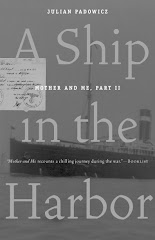
The good news is that I heard last week that “A Ship in the Harbor” placed second in the Connecticut Press Club’s annual competition. Not only is that very nourishing to the ego, but it will give me the opportunity to send out press releases and get some more exposure for the book.
The bad news is that it’s been some time since I’ve received any feedback to this blog, and I wonder if anybody’s actually reading it. So I’ve decided that unless I hear something encouraging from somebody out there, I will assume that no one is reading and quit writing it.
If you’re out there and want me to continue, please let me know either by responding here or by e-mailing me at julianpadowicz@julianpadowicz.com.
Over and out,
Julian Padowicz

Saturday, March 27, 2010

Last week I had the privilege of doing a book signing at the U.S. Holocaust Memorial Museum in Washington, DC.
My wife and I had been through the exhibits some months before and found the experience overwhelming. I didn’t see anything that I hadn’t seen before, but seeing it assembled the way it was made me wonder again how human beings could treat their fellow human beings with such viciousness. Then I remembered the way some of our fellow Americans used to treat African-Americans just a few decades ago, and I stopped wondering.
In any event, a few days ago I was sitting at a table in the Museum Bookstore with books of mine to the right of me, books of mine to the left of me, and a periodic announcement that a real-life survivor of the Holocaust was sitting at the back of the store, signing books. I wasn’t very comfortable with this characterization, since my own experience had been nothing like what was portrayed inside. My story wasn’t in enduring the Holocaust, but in escaping it. But here, on this afternoon, for the people who happened to be visiting that day, I was the embodiment of the Holocaust experience. It was a heavy load to carry.
Hundreds of people trooped through, mostly high school groups with teachers and chaperones, many glassy-eyed after what they had experienced inside. Some bought one or both of my books and had me sign it. Some just wanted my signature. Many wanted their picture taken with me. Some just stood there and looked at me.
One highschooler took one look at me and exclaimed, “Albert Einstein!” I explained to him that many older Jewish men tended to look like Einstein. Another, a high school junior, stopped by and, when we got to talking, she showed me a sample of a “T” shirt that her class was selling to raise funds for Darfur. Her name was Jessica Royce, and she had designed the logo herself. It was quite beautiful and professional looking, and she gave me one as a gift. If you want a beautiful “T” shirt for $12 and/or to donate to Darfur relief, contact her at JRquack20@aol.com.
At the end of my three-hour session I discovered that we had sold every one of the 52 copies of “Mother and Me” that they had on hand and some 15 of “A Ship in the Harbor.” As I walked back across the Mall to our hotel, I was exhausted by the experience, but encouraged by the feeling that, when my generation is gone, there will still be people who believe that the Holocaust really happened.

Sunday, March 7, 2010

Some time ago, as I started on my run, I felt an electric shock across my heart. I knew what electric shock sensations in that area mean and stopped immediately. As I stood there, for a minute or so, the shocks stopped as well.
Cautiously, I started walking, and the shocks did not return. But as soon as I took an experimental running step, there they were again.
I turned around and walked home. Then I got into the car and drove to an immediate care center. There, they did an EKG, which they pronounced perfectly normal. When I asked the doctor what the electric shock had been, he said he had no idea, but that I should take the EKG to my primary care doctor.
My primary care doctor did an EKG of his own, found everything normal, and had no idea what the electric shock might have been. He did, however, suggest a stress test.
I always enjoy stress tests, as the doctors have trouble stressing me on the treadmill. This one was no exception, and I got another clean bill of health. “So what was the electric shock all about?” I asked the cardiologist. If anyone would know, I figured, he’d be the one.
The cardiologist shrugged his shoulders, shook his head, and admitted to having no idea. I resumed my running with no further shocks.
A couple of weeks later, I was seeing my chiropractor for my monthly adjustment. “A funny thing happened when I was running, the other day,” I said, as he did his usual thing on my back. I was hoping that a little conversation would remind him that there was a human being on his table and he should be gentle.
“You thought you were having a heart attack,” he answered.
“Yes, I did, how did you know?”
“You have a rib out.”
Some weeks later I was at a cocktail party and found myself talking to a lady chiropractor. For want of something better to say, I launched into, “I have a funny story to tell you. I was running the other day and felt this electric shock across my heart.”
“You had a rib out,” she said.

Sunday, February 21, 2010

Last week I had some minor surgery. It was a painless, outpatient procedure that forced me to spend a few days being waited on at home by my wife, Donna, while I watched old movies on television. But it brought to mind a very different experience from some thirty years ago.

I was riding my motorcycle home from work, that time, and anxious to see the final game of the World Series. The Yankees were playing somebody, and I am a Yankees fan. But it seems that the previous owner of my BMW had put the wrong tires on it and, at 65 mph it went into a “high speed wobble” that culminated in me flying over the handlebars onto the concrete pavement of the Merritt Parkway.

When I came to, there were people telling me not to move and assuring me that I would be all right. Both an ambulance and a pickup truck were on their way, the pickup being to bring my motorcycle to the repair shop. It wasn’t till the EMS crew started to lift me onto the stretcher that I had any sense of my injuries, and that was excruciating pain in my chest and collarbone. As long as I lay still, I was all right, but the moment I tried to move or someone else tried to move me, no matter how carefully, the pain was terrible. As the ambulance backed up to the business end of Norwalk Hospital, I wondered whether I might be dying. If so, I remember hoping to live long enough to hear the outcome of the Yankees’ game.

In E.R., when I was helped to stand in front of the x-ray machine, I passed out. From then on, as I lay in bed in the Intensive Care Unit, it was a matter of coming to for short stays, then, for no apparent reason, passing out again. On the other side of the white curtain on my right, an old man was fighting for breath, groaning and gasping, possibly for the last moments of his life, and reminding me that, if I survived this, I still had that to look forward to, down the line. And, when I asked about the World Series score, no one seemed to know. I began to suspect that the Yankees had lost and they were withholding the news from me so that I might die in peace.

In addition, I was in a difficult place at the time. Earlier that year, my wife of 23 years and I had separated, much against my will, and I was trying to build a life without her. When the hospital people had asked me whom they should notify, I had named the lady that I had recently formed a relationship with, but said that they certainly should not call my estranged wife. But the hospital had played it safe and summoned my wife anyway, I suppose in the event that her signature was necessary for something. She had brought my thirteen year-old-daughter, as well, a decision I didn’t consider wise under the circumstances. And now, as I came in and out of lala land I would find my lady friend holding my hand on one occasion, my daughter on another occasion, my wife on a third occasion, and, sometimes, just a solicitous, six-foot tall, white rabbit, wearing scrubs.

It was determined that I had broken my collarbone in two places along with a liberal quantity of ribs, as well as rupturing my spleen. The ruptured spleen, I was told, was hemorrhaging into my body cavity and causing the loss of consciousness. And, if it wasn’t repaired within the next two hours, I would bleed to death.

At that point, with jolts of pain each time someone tried to move me, bleeding to death didn’t seem like the worst of my options. But someone signed the release, and I was told that that I would soon be going upstairs to Surgery. Being moved from my I.C.U. bed onto a gurney for the trip upstairs seemed like a “via dolorosa” that I would just as soon pass up.

Then a miracle happened. A woman in the colorful scrubs of the O.R. appeared at my bedside, introduced herself as my – my very own – O.R. nurse, who, she promised, would be with me through the entire procedure. Then she went on to inform the orderlies that I was going upstairs in my own I.C.U. bed, rather than the rinky-dink contraption they were anxious to transfer me on to. Taking her outstretched hand, I felt as though I was holding hands with an angel, and we proceeded to ascend into the higher regions of Norwalk Hospital.

I’ve never seen that nurse again, nor would I recognize her if I did. But I do remember the feel of her hand in mine and the wonderfully comforting sense that a caring person had just committed herself to being “with me” through the entire ordeal.

Last week, as Donna, and I sat in the waiting room for what was to be much less of an “ordeal” and under far less stressful circumstances, instead of the usual technical person struggling with the pronunciation of my name from across the room, an O.R. nurse in the colorful scrubs of that profession came to where we were sitting, introduced herself, and explained that she would be “my” nurse for the procedure. She didn’t offer her hand this time, so I don’t know if it would have felt the same. But that wonderful sense of a total stranger appearing out of the blue to care, was there again.

By the way, the Yankees won that Series as well.

Saturday, February 6, 2010

Recently, I told you about my undistinguished, fictional friend Kip, rattling around in the back of my head, and the book, “Writer’s Block,” that I had to write in order to get rid of the rattling. What I didn’t tell you was that the rattling didn’t stop with the end of the book. It seems that I got so deeply involved with Kip and his friends that I found myself suffering withdrawal symptoms and immediately set about writing a sequel. After finishing the sequel and some wondering what to do next, I still had so much unfinished business with Kip that I decided to do a trequel.

In writing the original sequel, I began with Kip and Amanda in Europe, where I had left them, and proceeded to bring them back to the little Village of Venice, Mass., where Kip is now a local hero because of what he did in the original book, plus the book he has written while in Europe. This immediately set up a broad range of possibilities and I began writing the opening chapter without bothering to do an outline, but with the confidence that, with all the possibilities, something would develop.

And it did. But, as I approached the trequel, I did not see the natural plot possibilities ahead of me, and decided to do an outline so that I would know where I was heading. And that outline required a dramatic ending in which Kip confronts the abusive father of a troubled fourteen-year-old boy, whom he is mentoring, that convinces the boy that he cares about him.

This gave me a very confined stage to work on. Being seventy years old, Kip is not about to get into a fist fight with the man, and I just could not come up with a way of resolving the conflict between the two men that would be in keeping with the tone of the story. Usually, my run/walks produce solutions to such problems, but no ideas that this technique developed seemed to fit the situation.

Then I asked the advice of a friend of mine, who is a therapist. “Is there some exercise for extending your creativity?” I asked him. “Something to help you to think ‘outside the box’?” My wife has a wonderful capacity for thinking outside the box, which I very much envy.

“What you do,” my friend suggested, “is tonight, before going to sleep, you ask your unconscious to help you.” My friend is a disciple of Milton Eriksen, the famous hypnosis therapy guru, and I should have known that he would suggest this approach to the problem.

“You tell your unconscious how grateful you are for all the ways it has helped and protected you throughout your life,” he continued, “because the unconscious is very susceptible to flattery, you know, and then ask it to help you to find a solution to your problem.” He also explained that the unconscious is generally quite inclined to help you in life since it knows that, “if you’re out of business, it is out of business.” Then he added, “You may wake up with a solution.”

That night, I tried my friend’s technique. I was, of course, skeptical, but I had nothing to lose and a lot to gain. As my wife turned out the light, after watching one of the BBC comedies that we enjoy so much, I turned my attention to my unconscious and, following my friend’s instructions, said something like, “I want to thank you for all the ways that you’ve helped me and protected me in the past.” As you can imagine, it wasn’t easy saying that, even silently and in the dark, but I continued. “But now I need your help in a small writing problem. As you probably know, I’ve got to come up with some kind of dramatic conflict between Kip and Erik’s father that will convince the troubled Erik that Kip cares about him. I’ve been looking for a solution for a couple of weeks now, and I need to start thinking more outside the box.” Then I went to sleep.

The next morning I woke up with a headache. The temptation was to take that as a “Do not disturb.” I could visualize my unconscious playing Chinese checkers with my libido. I was tempted to say, “I knew it wouldn’t work,” but didn’t dare to, just in case someone was listening.

Later in the morning I went for my run and, about a mile and a half into the run it occurred to me to introduce a third element into the confrontation, along with Kip and Erik’s father – a hurricane.

In a more serious drama, introducing a hurricane at this particular point would be considered gimmicky. But this is a humorous story and, in that context, I felt it would be acceptable. So I wrote in a hurricane and Kip’s concern for his new sailboat which needs to be secured against the wind, but he is not willing to leave Erik alone with the abusive father, and I had a dramatic climax.

In the week or so since then, I have found myself coming up with solutions to other problems that I consider to be from “outside the box.” As you can imagine, for a writer of fiction, this is, indeed, a valuable ability. In the past I have considered myself a good “storyteller,” that is someone who can do a good job dressing up a story, once there is a story to dress up. But I have considered myself weak in the area of actually creating a story. Now, hopefully, with the help of my new internal friend, this will all improve. You might give it a try.

Tuesday, January 26, 2010

It seems that I’m making history.
The other day a relative e-mailed me some information she had dug up in “Google” about my family. Among other things, the article said that my mother had two sisters-in-law, named Edna and Paula. Edna and Paula are the names that I assigned to my two aunts, in my book, “Mother and Me.” Their names weren’t Edna and Paula. As I explained in the “Author’s Note” at the beginning of the book, I assigned fictitious names to some of the characters, since I could not rely on my sixty-plus-year-old memory to treat them fairly and didn’t want to embarrass anyone. Apparently the author of the article did not bother to read that disclaimer, and my two aunts will go down in history under assumed names.
Then there is the matter of my father. Those of you who read “Mother and Me” may recall an incident along the road from Warsaw where we encounter a Polish military convoy with a broken-down truck and a young lieutenant who wants to commandeer ours. To stop him from doing that, my mother tells him a big fib about the truck belonging to my father and about my father being a senator. I believe that I made it quite clear in the book that this is one of the fibs that my mother would use to solve problems and which drove me crazy. But, apparently, the fib fooled not only the young lieutenant, but the author of the “Google” article as well. My father, who had been a businessman in the textile business, is now duly ensconced in the annals of Polish history as a senator.
I can’t help wondering how accurate the rest of the supposedly authoritative articles on the Internet really are.